



Artificial Intelligence tools have become an essential part of daily workflows for marketers, developers, content creators, researchers, and businesses. So when Anthropic’s Claude AI experienced another widespread service disruption in June 2026, users across the globe quickly took notice.
Thousands of users reported problems accessing Claude AI, with many encountering blank responses, failed prompts, and interrupted conversations. The outage sparked discussions across social media and outage-monitoring platforms as users searched for answers and updates.
What Happened?
On June 18, 2026, Claude AI users began reporting service interruptions across multiple regions. According to user reports, the platform was either failing to respond to prompts or returning incomplete and blank outputs.
Anthropic acknowledged the issue on its official status page and confirmed that the engineering team had identified the cause and was actively working on a fix. The company later reported that a solution had been implemented and that services were being monitored before eventually declaring the incident resolved.
Issues Reported by Users
During the outage, users experienced:
- Failed prompt submissions
- Blank or incomplete responses
- Delayed processing times
- Service interruptions across Claude.ai
- Difficulty accessing ongoing conversations
Many professionals who rely on Claude for content generation, coding assistance, research, and business tasks found their workflows temporarily disrupted.
Not the First Outage in June
The June 18 incident was not an isolated event.
Earlier in the month, Claude experienced another significant disruption that affected multiple services, including Claude.ai, Claude API, Claude Console, and Claude Code. Anthropic identified the issue and implemented corrective measures, but the recurrence of service interruptions has raised questions about platform reliability as adoption continues to grow.
Anthropic’s public status history also shows several incidents involving elevated error rates across various Claude models throughout June 2026, including Opus, Sonnet, and Haiku models. Most incidents were resolved quickly, but the frequency highlights the operational challenges of scaling advanced AI systems.
Why Do AI Outages Happen?
Large AI platforms operate on massive computing infrastructure and serve millions of requests daily. Outages can occur due to:
- Sudden spikes in user demand
- Infrastructure failures
- Capacity constraints
- Network issues
- Model deployment challenges
- Backend service disruptions
Industry experts note that as AI adoption accelerates, maintaining reliability becomes increasingly complex. Even leading AI providers occasionally experience service interruptions while managing rapid growth and infrastructure scaling.
What This Means for Businesses
The recent outage serves as a reminder that AI platforms, despite their capabilities, remain cloud-based services subject to technical disruptions.
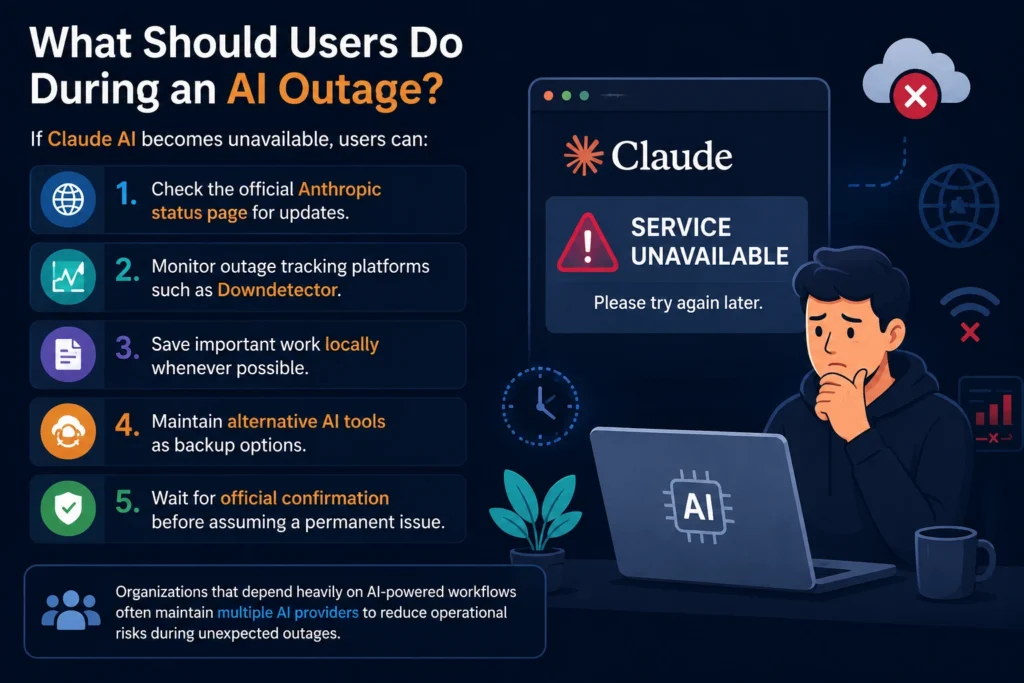
Businesses integrating AI into critical operations should consider:
- Backup workflows
- Multi-provider AI strategies
- Data redundancy
- Operational contingency plans
As AI becomes increasingly embedded in business processes, resilience and reliability will become just as important as model performance.
Final Thoughts
Claude AI’s latest global outage demonstrates both the growing dependence on AI tools and the challenges providers face in maintaining uninterrupted service at scale.
While Anthropic resolved the incident and restored operations, repeated disruptions during June have prompted users and businesses to think more carefully about AI reliability and backup planning.
For now, Claude services appear to be operational again, but the incident highlights an important lesson: when AI becomes part of your daily workflow, having a contingency plan is no longer optional as it’s essential.