


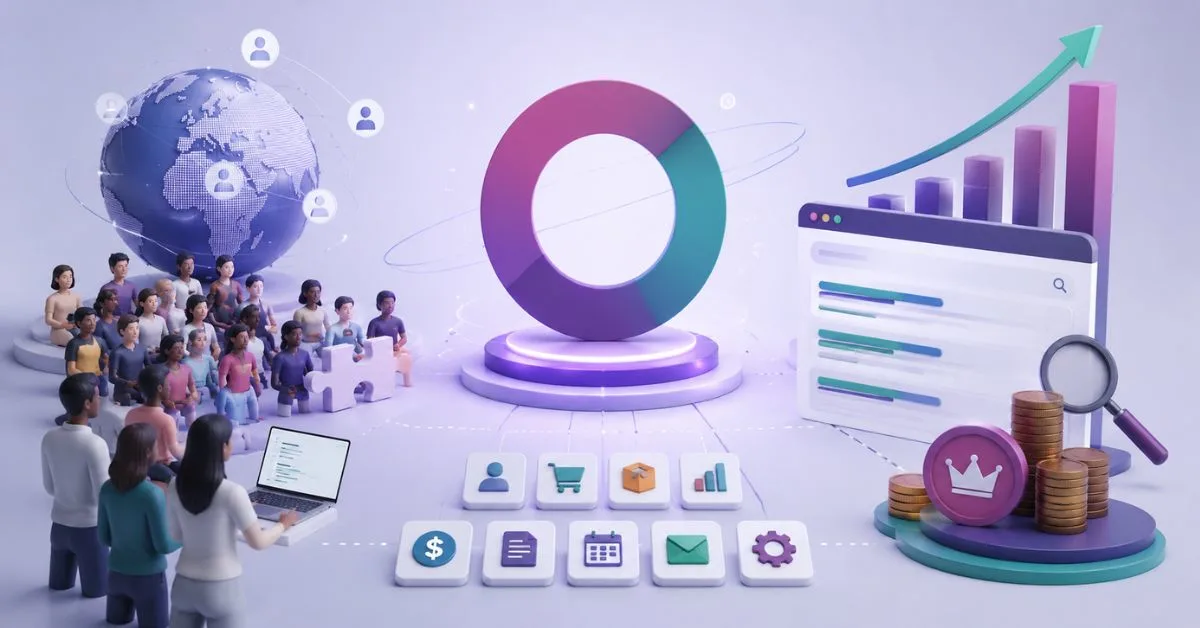
Reinventing ERP for the Modern Business
Enterprise Resource Planning (ERP) systems are the lifeblood of modern business operations. Traditionally dominated by legacy players like SAP, Oracle, and Microsoft Dynamics, the ERP market was considered impenetrable—until Odoo ERP rewrote the rules. Leveraging a community-driven approach, a clever freemium model, and an aggressive SEO strategy, Odoo scaled from a small Belgian startup to a global software powerhouse with over 7 million users worldwide.
In this post, we’ll dissect how Odoo ERP strategically combined its open-source community, freemium business model, and SEO-first growth engine to outmaneuver traditional competitors and redefine accessibility in the ERP space.
What They Did: The Three-Pronged Strategy of Odoo ERP
Odoo’s rise is a textbook example of disruptive growth using low-cost, high-leverage strategies. Rather than competing head-to-head on expensive enterprise sales models, Odoo focused on three pillars:
1. Open-Source Community as a Force Multiplier
Odoo ERP was born as TinyERP in 2005 and rebranded in 2014. From the beginning, its founder Fabien Pinckaers believed in the power of community. The core product was released as open-source software, allowing developers and businesses to use, customize, and contribute to it freely.
By embracing an open-source philosophy:
- Odoo attracted a global network of 35,000+ developers.
- It fostered an ecosystem of over 30,000 apps available via the Odoo App Store.
- The community provided free R&D, localization, and bug fixing.
This grassroots adoption built trust and virality, especially in developing markets where enterprise ERP was unaffordable.
2. Freemium Model that Scales
Most ERP providers operate on high-margin, license-based models. Odoo flipped the script with a freemium pricing model:
- Free for one app (e.g., CRM, Invoicing, or Inventory).
- Paid plans start only when businesses scale usage across multiple apps or users.
- On-premise (Community Edition) remains completely free and open-source.
- Cloud-hosted (Odoo Online) is the monetized offering.
This model allowed Odoo to:
- Onboard users with zero friction.
- Let businesses grow into paying customers organically.
- Create a low customer acquisition cost (CAC) funnel with high lifetime value (LTV).
3. SEO as a Growth Engine
Instead of expensive ads or outbound sales, Odoo invested in SEO at scale. By building thousands of SEO-optimized pages for each app, feature, and use case, they captured organic traffic from business users worldwide.
Their content strategy focused on:
- High-ranking pages for terms like “free CRM,” “open-source ERP,” “inventory management software,” etc.
- Product comparison pages: “Odoo vs SAP,” “Odoo vs QuickBooks.”
- Detailed documentation and tutorials indexed by Google.
- Localized pages for dozens of countries and languages.
The result? Millions of monthly visits with very low marketing spend compared to traditional SaaS players.
Channel Mix: How Odoo Balanced Organic and Community Channels
1. Organic Search (SEO-First Mindset)
SEO was more than a traffic channel—it was Odoo’s go-to-market strategy. By mapping keywords to user intent and building content for every stage of the buyer journey, Odoo dominated search results. Key tactics included:
- Long-tail keyword targeting: e.g., “free invoicing software for freelancers.”
- Technical SEO: Fast site speed, mobile optimization, and structured data.
- Content localization: Serving content in over 20 languages.
As a result, Odoo ranks on page one for hundreds of ERP-related keywords, driving over 5 million monthly organic visitors as of 2024.
2. Developer and Partner Community
Odoo invested heavily in its partner ecosystem. With over 4,000 certified partners worldwide, Odoo expanded its reach and provided implementation and support services without building a large internal team.
- Partners generated local leads via word of mouth.
- Developers contributed new features and apps.
- Odoo organized Odoo Experience, an annual conference attended by 10,000+ community members.
This channel served as a dual engine: product improvement + distribution.
3. Product-Led Growth (PLG)
Odoo’s freemium model naturally led to product-led growth. Businesses could sign up, use the software, and only upgrade when needed. No salespeople, no demos—just value delivered upfront.
- In-app upsells and upgrade nudges.
- Usage analytics to convert free users.
- Self-serve onboarding with guided tutorials.
This created a viral loop where satisfied users invited teammates or explored additional apps.
Results: How Odoo ERP Disrupted the ERP Industry
The numbers tell the story of one of the most efficient SaaS growth engines ever built.
1. Explosive User Growth
- Over 7 million users as of 2025.
- Adoption in over 120 countries.
- Users range from startups to enterprises with 1,000+ employees.
2. Low Customer Acquisition Cost
- Odoo spends significantly less on marketing compared to SAP or Oracle.
- SEO and freemium onboarding drive organic, cost-efficient growth.
- Partners and developers function as a distributed sales force.
3. Rapid App Ecosystem Expansion
- 30,000+ community apps.
- Use cases range from HR and eCommerce to manufacturing and IoT.
- Businesses can fully customize the ERP to their specific workflows.
4. Competitive Market Position
Odoo now competes directly with:
- SAP Business One
- Oracle NetSuite
- Microsoft Dynamics
- Zoho and QuickBooks for smaller firms
Unlike many ERP systems that are either too rigid or too expensive, Odoo’s modular, flexible, and accessible approach appeals to a much wider audience.
Lessons from Odoo ERP: Community + Freemium Model + SEO Done Right
What can startups and SaaS companies learn from Odoo’s success?
1. Open Source + Community = Scale
Odoo ERP shows how community is not just a support mechanism—it’s a scaling engine. Community-contributed apps, documentation, and localization allow for faster, cheaper growth.
2. Freemium Isn’t a Loss Leader—it’s a Sales Funnel
By making the core product free, Odoo built a product-led sales funnel. Users opted in because of value, not pressure, leading to higher retention and trust.
3. SEO is Not Just Marketing—It’s Distribution
Instead of paying for leads, Odoo engineered its content for discoverability. Every app, feature, or integration had a landing page optimized for search, creating thousands of entry points.
Final Thoughts: The Future of ERP is Open, Modular, and Organic
Odoo ERP didn’t just build software—it built a movement. Through smart use of community engagement, a freemium pricing strategy, and scalable SEO, it transformed what was once a stale, enterprise-only market into something dynamic and accessible.
In a world where CAC is rising and paid ads are increasingly inefficient, Odoo proves that organic growth fueled by community and content can still win. Their success is a masterclass for startups, SaaS businesses, and open-source projects alike.
Whether you’re building an ERP, a CRM, or any SaaS product, remember the formula:
Odoo ERP = Community + Freemium Model + SEO = Scalable Growth
Note: The above details are sourced from the information available in publicly accessible records and online sources.