



If you’ve spent any time in marketing circles lately, you’ve probably heard “Claude” mentioned in the same breath as ChatGPT. But what is Claude AI, and does it actually deserve a spot in your marketing stack?
This guide is the answer — written for marketers, not engineers. By the end, you’ll understand what Claude is, who built it, how it stacks up against ChatGPT, and exactly where it fits into real marketing work like content creation, research, and campaign planning. No hype, no jargon. Just a clear first look.
Quick take: Claude is an AI assistant built by Anthropic. Marketers use it for writing, research, data analysis, and building simple tools — and it has a reputation for high-quality, natural writing and fewer made-up “facts” than some rivals.
What Is Claude AI, Exactly?
Claude is a conversational AI assistant — a chatbot you talk to in plain language, much like ChatGPT or Google Gemini. You type a request (“write me five Instagram captions for a coffee brand”), and Claude responds in seconds.
Under the hood, Claude is powered by a family of large language models (LLMs) built by Anthropic, an AI safety company founded in 2021 by former OpenAI researchers. You can use Claude for free at claude.ai, through its mobile and desktop apps, or build it into your own tools via an API.
What marketers tend to notice first is the writing quality. Claude is widely praised for producing natural, human-sounding copy and for being more cautious about inventing facts than some competitors — a meaningful advantage when you’re publishing content with your brand’s name on it.
Where the name comes from
Anthropic releases Claude in tiers named after writing forms such as Haiku, Sonnet, and Opus, from fastest-and-cheapest to most-capable. Think of them like shipping speeds: Haiku is the quick everyday option, Sonnet is the balanced workhorse most people use, and Opus is the heavyweight for complex jobs.
Who Makes Claude? (And Why It Matters)
Claude is made by Anthropic, a company built around the idea of developing AI safely. Their signature approach is called Constitutional AI, a training method designed to make Claude helpful while following a clear set of behavioral principles.
Why should a marketer care about the company’s philosophy? Two practical reasons:
Brand safety. Claude is built to avoid harmful, biased, or off-brand outputs, which lowers your risk when using it for public-facing content.
Privacy. Anthropic states it does not train its models on your submitted data unless you explicitly opt in — relevant if you’re feeding it client briefs or unpublished campaigns.
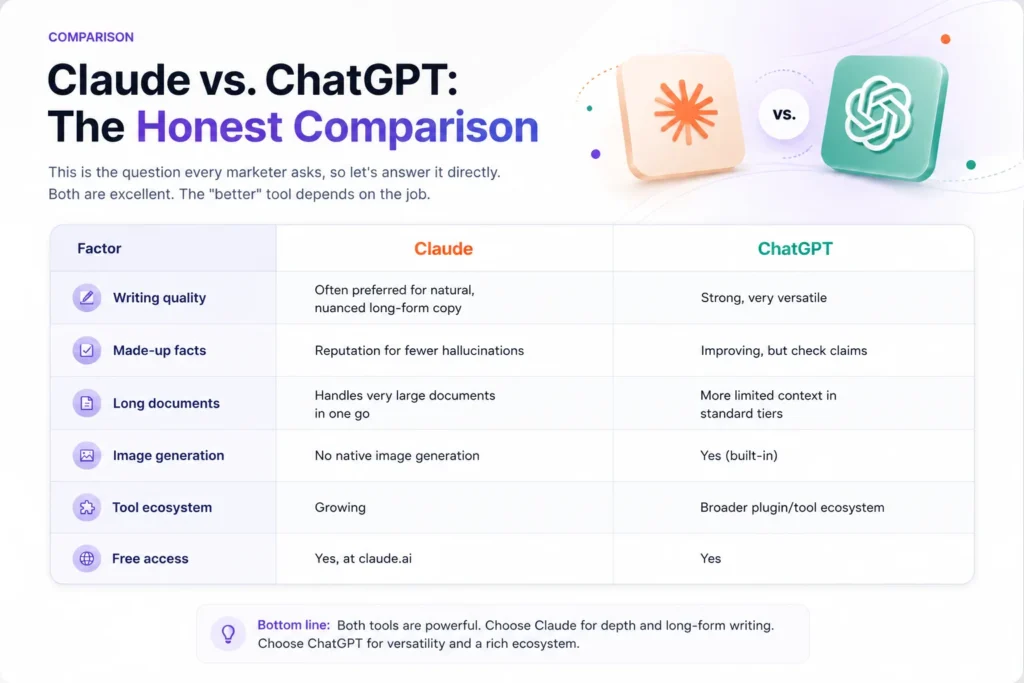
Tip: You don’t have to choose. Many marketers keep both open — Claude for drafting and analysis, ChatGPT when they need image generation or a specific plugin. Use the tool that wins the task in front of you.
6 Ways Marketers Actually Use Claude
Here’s where theory meets practice. These are the use cases we’ll explore in depth across this series.
1. Content Creation
Blog drafts, email sequences, ad copy, social captions, video scripts, and landing-page text. Claude’s writing quality makes it a genuine drafting partner rather than just an idea generator.
2. Research & Strategy
Ask Claude to summarize a long industry report, compare competitor positioning, or brainstorm a campaign angle. It can digest large amounts of information and hand you the key points.
3. Document & Data Analysis
Upload a PDF report, a messy spreadsheet, or a customer-feedback export and ask Claude to find the patterns, pull out quotes, or summarize the takeaways.
4. SEO Support
Draft meta descriptions, cluster keywords into topics, build content outlines, and generate FAQ sections — all useful inputs for an SEO workflow (though human review stays essential).
5. Repurposing Content
Turn one blog post into a LinkedIn carousel, a newsletter, five tweets, and a video script. Repurposing is where AI saves marketers the most time.
6. Building Simple Tools
Claude can generate small interactive tools like calculators, quizzes, simple web pages, that you can use as lead magnets or on-page assets, even if you don’t code.
How to Try Claude in the Next 10 Minutes
- Go to claude.ai and sign up free with an email — no credit card needed.
- Start with one simple, real task. Try: “Write three subject lines for a welcome email from a [your niche] brand. Make them friendly and curiosity-driven.”
- Refine with feedback. Tell it what to change: shorter, punchier, more formal. This back-and-forth is where the magic happens.
- Save what works. Keep a notes file of prompts that consistently deliver good results.
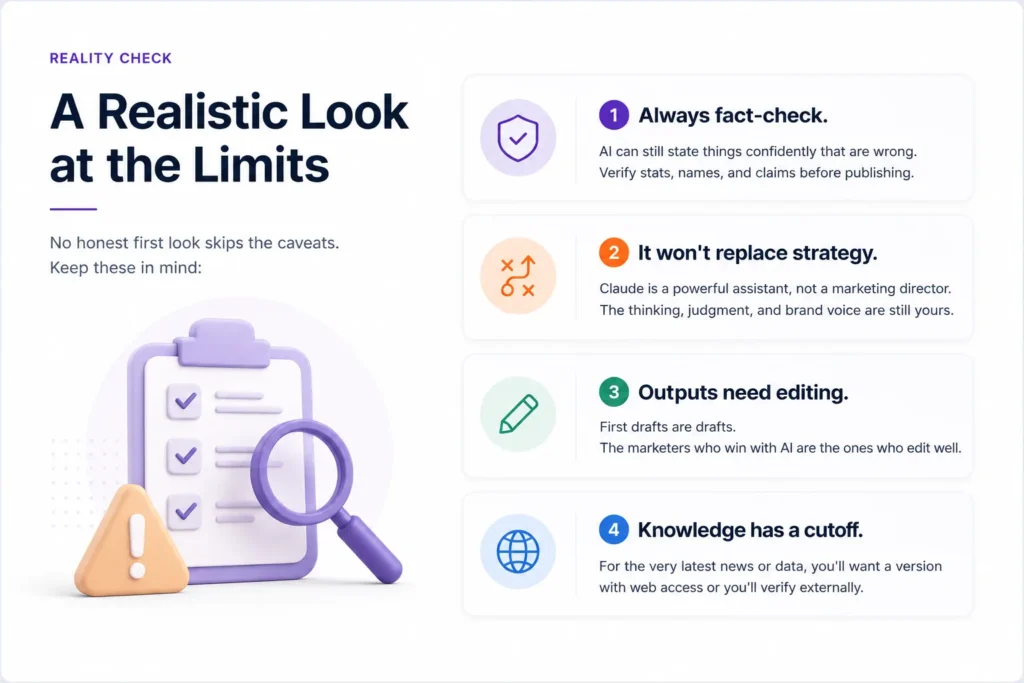
Claude AI is a serious, marketer-friendly tool — strong on writing, careful with facts, and built by a company that takes safety seriously. It won’t do your strategy for you, but as a daily drafting, research, and analysis partner, it’s one of the most capable options available right now.
This post is the hub for everything we publish on using Claude in marketing. Bookmark it — every future Claude guide we write will link back here.
Frequently Asked Questions
Is Claude AI free? Yes. You can use Claude for free at claude.ai by signing up with an email address. There are daily usage limits on the free tier, with paid plans available for heavier use and access to the most capable models.
Is Claude better than ChatGPT for marketing? Neither is universally “better.” Claude is often preferred for natural long-form writing, analyzing long documents, and trustworthy output. ChatGPT offers native image generation and a broader plugin ecosystem. Many marketers use both.
Who owns Claude AI? Claude is built by Anthropic, an AI safety company founded in 2021 by former OpenAI researchers.
Can Claude write blog posts and ad copy? Yes. Content creation is one of its most popular marketing uses — blog drafts, email sequences, ad copy, and social captions. Always edit and fact-check before publishing.
Does Claude use my data to train its AI? Anthropic states it does not train its generative models on user-submitted data unless the user explicitly gives permission.